
Early orthodontic treatment
Why the AAO recommends an orthodontic evaluation by age seven, what early treatment corrects, and when to wait. CDZ Ortho in Johns Creek.

Why age seven
The American Association of Orthodontists recommends a first orthodontic evaluation by age seven.
By that age the first adult molars and incisors have usually come in, which is enough for an orthodontist to see how the bite is developing and whether the jaws are growing in proportion.
Most children examined at seven do not need treatment then. The visit establishes whether anything needs attention now and sets a point to review from.

From Dr. Cen
Why we see kids by age 7
What early treatment corrects
Early treatment, sometimes called Phase 1, addresses problems that are easier to fix while the jaw is still growing.
A narrow upper jaw. An expander widens the upper arch. This works cleanly in a growing child because the two halves of the palate have not yet fused. In an adult the palate has fused, so the same skeletal widening is harder to achieve and may need a surgical or skeletally anchored approach.
Crossbite. When upper and lower teeth meet on the wrong side of each other, the jaw often shifts to one side to close. Left alone, that shift can affect how the jaw grows.
Severe crowding. Creating space early can reduce the likelihood of needing extractions later.
Protruding upper front teeth. Teeth that stick out well forward are at higher risk of being broken in a fall or impact during sports.
Habits. Thumb sucking and tongue thrust past a certain age change how the front teeth and the palate develop.
Early loss of a baby tooth. A space maintainer holds the gap so the adult tooth underneath has room.
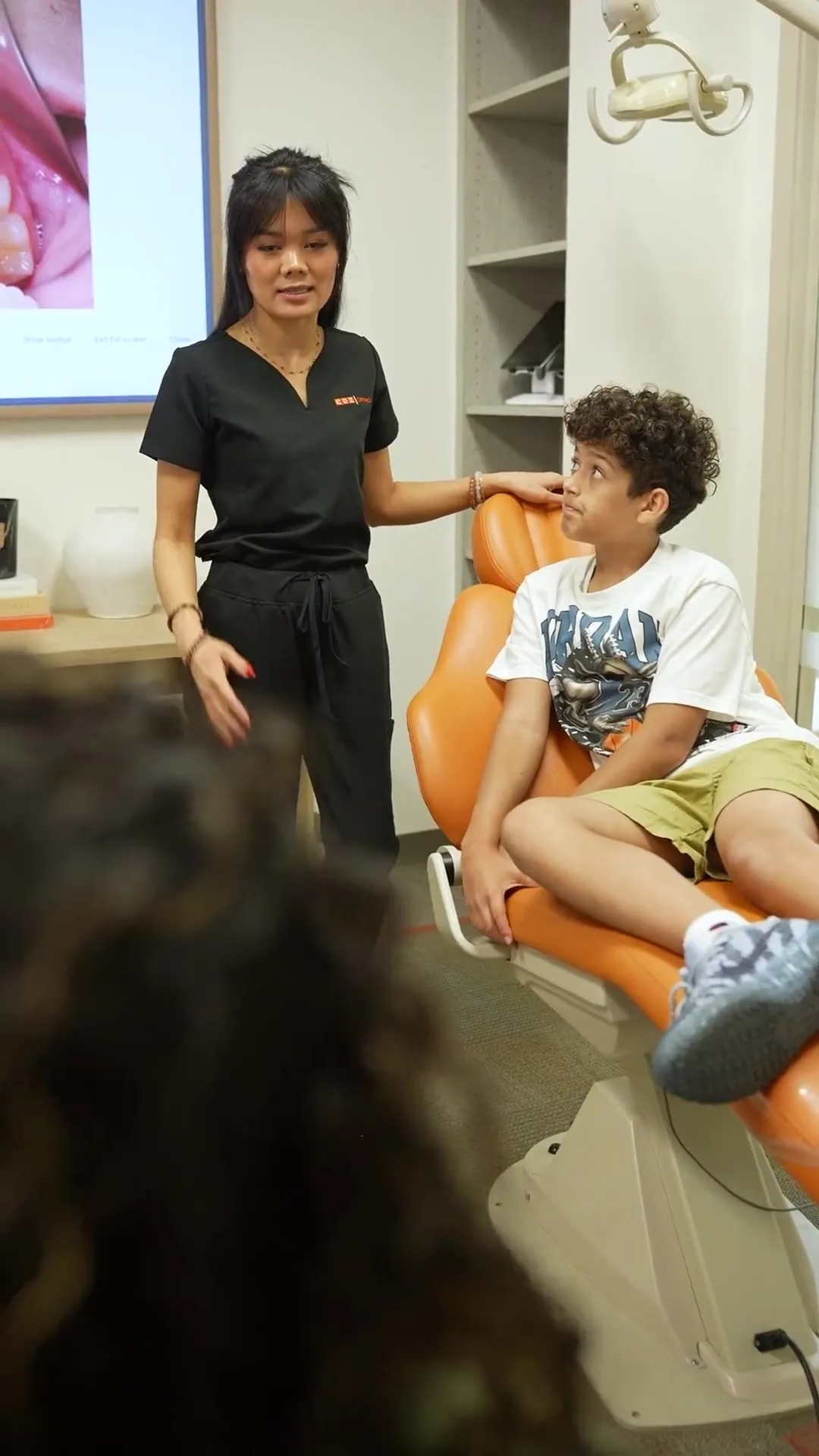
Two phases
Phase 1 usually happens between ages seven and ten and is limited in scope. It corrects the specific problem and then stops.
A retention period follows while the remaining adult teeth come in.
Phase 2 happens in the early teens once all the adult teeth are present, and aligns the full set. Not every Phase 1 patient needs a full Phase 2.
When waiting is the right answer
Early treatment is not better by default. Treating too early can mean a longer overall course, more appointments, and a child in appliances for years.
For most children the correct answer at seven is to monitor and start when the adult teeth are in.
Where treatment is not needed yet, Dr. Cen sets a review interval and sees your child again at the right point rather than starting early.